
For this AAPI Heritage Month
Uplifting our stories to battle layers of erasures
The Trump administration has ‘canceled’ all heritage/history month programs in the federal government. As my friend, poet Bao Phi noted recently, in all the media and discourse over the awfulness of canceled programs there’s almost no mention that AAPI Heritage Month is gone too. I’ve seen the same in news reports of the closures of culturally-affirming programs and academic units in higher education too. It’s a frustratingly weird erasure of the AAPI experience of erasure.
A long time ago I realized that we can’t wait for others to recognize our existence. I remember saying to Karthick Ramakrishnan that we can’t keep calling on public institutions to collect and analyze ethnically disaggregated data on AAPIs. A few years later, he created AAPI Data ❤️.
As Catherine Ceniza Choy offered in Asian American Histories of the United States, the three pillars of Asian American histories are violence, erasure, and resistance.
For this AAPI Heritage Month, I’m noticing all three of these themes of violence, erasure, and resistance, and how they persist through time.
Because our stories cannot be contained within one month - canceled or not by MAGA - I’ve been facilitating the Asian American 101 monthly book club at Restoried Bookshop in Albany Park, Chicago. We should be learning about and reflecting on all of our stories every month! We read a couple chapters a month.
For this AAPI Heritage Month, Catherine Ceniza Choy visited our book club via Zoom!
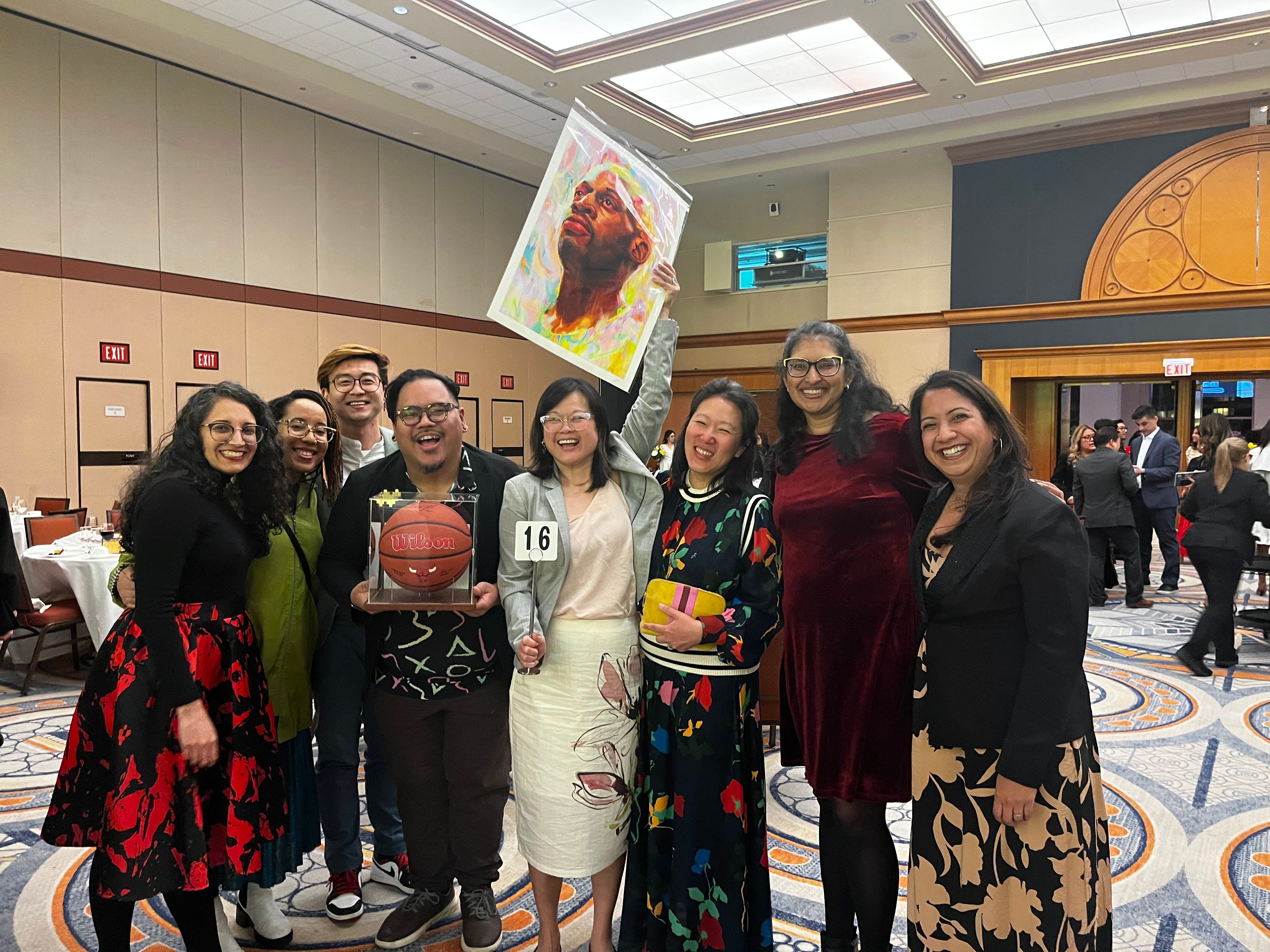
For this AAPI Heritage Month, I have been celebrating loudly and resisting erasures. I hosted a table at the Chinese Mutual Aid Association (CMAA) of Chicago. I’ve been a Board member since July 2025, and was delighted to have friends join me at Table 16! Our friend Mark Anthony Florido won the Bulls prize package in the silent auction. It included a portrait of Dennis Rodman!
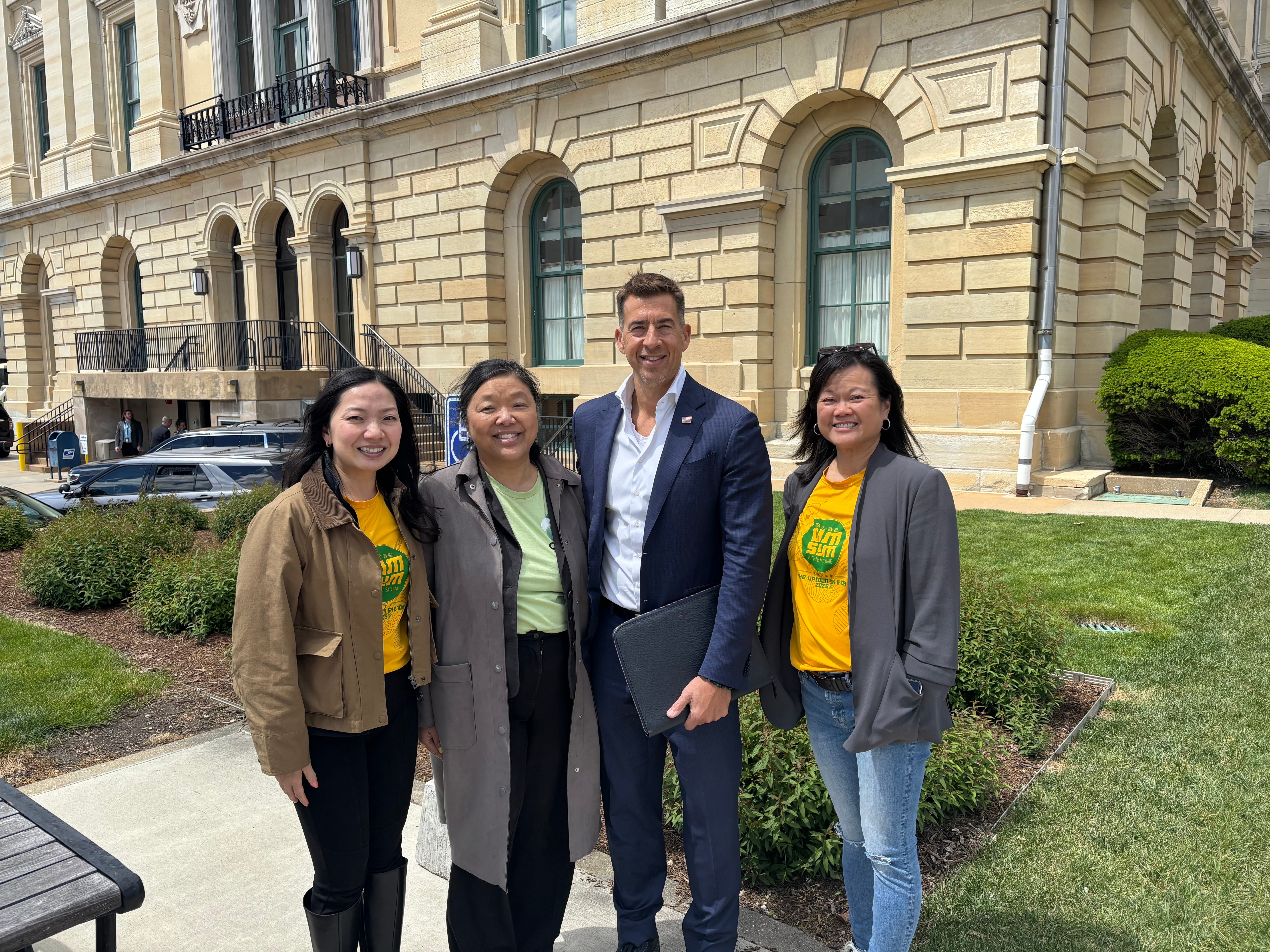
A week later, I joined the CMAA delegation at the State Capitol in Springfield for the annual Asian American Action Day, and got to meet State Secretary Alexi Giannoulias.
We have also witnessed tragic violence in our community. On Monday, May 18, two white supremacists attacked a Mosque in San Diego, killing three heroes (Amin Abdullah, Mansour Kaziha, and Nader Awad) whose actions prevented the murderers from reaching the school.
For this AAPI Heritage Month, I want to honor Abdullah, Kaziha, and Awad, and their families. If Asian American is not a color, then what is it? It is about solidarity and collective resistance, as comedian Jenny Yang reminded East Asian Americans and Wasians, we need to step up into the heart of what it means to be Asian American and support the Muslim community in San Diego right now, and fight Islamophobia whenever and wherever.
Finally, for this AAPI Heritage Month, I’m continuing my mini-series of essays: “What can you do with an Asian American Studies major/minor?”
In recognition of my book baby, Asian American is Not a Color’s 2nd birthday, I interviewed Cindy Kay Vo, who was the narrator for my book!
One way we can resist the violences and erasures we experience as Asian Americans and Pacific Islanders is through storytelling for the people. That’s what Cindy does.
What do you do with an Asian American Studies degree? You become an award-winning Audiobook Narrator!
Do you listen to audiobooks? Between 2023 and 2024, the sales of audiobooks grew by 13%, reaching $2.22 billion (with a B). The Audio Publishers Association reported that in 2025, an estimated 51% of adults in the US have listened to an audiobook.
Count me in these increasing numbers of audiobook consumers! I especially prefer using my Libro.FM account, connected to Call & Response Books, and my Libby account to borrow from the public library, to listen to non-fiction. It fits well in my on-the-go lifestyle. While doing chores or when riding on the bus, train, or driving long distances, I’ll have my audiobook cranked up to 1.3x speed.
As a first-time trade press author (shout out Beacon!), I had the opportunity to decide whether I wanted to narrate my own non-fiction book or choose a professional narrator. Audiobooks were not part of the deals with my first two books, which were published with academic presses.
I don’t like hearing my own recorded voice, so I didn’t think twice about it. I wanted a pro to record my audiobook. I also told the Beacon team that I would only sign off on a narrator who also identified as an Asian American woman. I was open to any ethnic identities.
Beacon sent me four recordings from professional audiobook narrators. My husband, Té Té, and I listened to the four recordings, and quickly narrowed it down to two. After listening to our two finalists again, we all favored Cindy Kay Vo. She nailed the recording of dialogue in my book between me and toddler Té Té. Cindy said “Asian Khmerican” exactly right, even acting out how a toddler would sound out new words!
When I looked up Cindy’s background and qualifications, I knew she was my book’s narrator. The fact that she had been an Asian American Literature professor sealed the deal for me.
For this essay on folks who studied Asian American Studies and what they do now professionally, I finally got to virtually connect with Cindy and ask her the question on my mind.
A Love of Reading
As a college professor, “especially when you’ve been teaching for so long, sometimes [reading] gets a little bit rote.” It can become mundane, even for those of us who started our pathways into the academy as book lovers.
For Cindy, it was a summer reading program at a local library that sparked her love of reading, when she was six years old.
I totally remember how you would take these steps up to the children’s section up in this little, tiny loft area in the library. And then the lady who was running the children’s section had built a fake front on her desk to look like she was sitting in a castle, with painted turrets and stuff like that.
The magic of her local library’s children’s section and summer reading program helped Cindy’s school performance. She recalls going from the lowest reading group in her first grade to reading 60 books that summer, to joining the top reading group in the second grade. Perhaps more importantly, it also inspired a fantastic imagination.
Growing up, Cindy wanted to be a “cat burglar” with a heart for justice, encouraged by reading murder-mystery and middle-school who-dun-it books, like the Trixie Belden and Nancy Drew series. She really liked the idea of “sneaking around and making things right, getting revenge on people who deserved it or being kind of like Robin Hood, and wearing a cool black outfit!”
At home with her toys, she was a budding feminist storyteller.
For some reason, all of my little pretend afternoons would involve Barbie kicking Ken out because I didn’t have a Ken. So, I would just pretend I kicked him out and then, she and her friends would go on these trips and then do all this like off-roading, and just going on adventures by themselves.
Still, her family expected her to become “a doctor, a wife and a mother. It wasn’t a question.” After all, her parents had immigrated to from Thailand, so her father could pursue a career as a medical doctor. It was a common immigration pathway for Asians as a result of the 1965 Hart-Cellar Act—an experience dramatically staged in Lloyd Suh’s iconic play, The Heart Sellers.
Cindy followed the medical professional pathway set out for her until college. There, she realized that her love of science and frustrations with math could not carry her through a pre-med major and into a career as a medical doctor.
Telling her family that she was pivoting to pursue an English degree “was a huge rip off the Band-Aid moment. Being an Asian kid back then, this was not really done.” Although her family didn’t take the news well at first, they encouraged Cindy to “be the best at whatever path” she took. And this led to the Ph.D. as a “non-negotiable” for her.
In her journey toward successfully completing her doctorate, Cindy benefited from the mentorship of professors she admired. Shortly after grad school, she landed a tenure-track position and eventually earned tenure.
Reconnecting with Books
During her dozen years as a Literature professor, Cindy was “surrounded by books, but not fully inside them.” There is a difference between thinking about texts and feeling texts.
Professors read books and research articles in support of our scholarly careers. But reading out loud is not a required task in the academic’s job. Speed reading is a great way to think about ideas in texts, to figure out how a line of inquiry connected with existing research, to learn research methods, and of course to follow intellectual curiosities. Academic reading can be reduced to a functional, and not joy fille, activity.
Some time in her university-based scholarly career, Cindy began volunteering with Learning Ally, which is a literacy nonprofit organization that supports learners with reading differences such as dyslexia. She would read books to K-12 students, who learned better when listening to texts, and learned that she really enjoyed reading books out loud. Eventually in 2017, one of her colleagues at the organization suggested that she consider narrating books professionally.
Since 2019, when she left her tenured faculty position, Cindy has recorded nearly 500 books, including many published with the most prominent publishing houses. She is now an award-winning audiobook narrator, with an Audie Award in Romance (Christina Lauren’s The Love Experiment), six Earphones awards, and lots of kudos in reviews including from the American Library Association.
Tips for Becoming a Professional Audiobook Narrator (with a Grain of Salt)
Leaving the academy didn’t mean Cindy was starting over from scratch. The skills she developed in her academic career served her well. Solid skills in literary analysis allows her “to find the meaning behind why authors wrote what they did.”
One thing Cindy had to work on before pursuing full-time work in audiobooks was acting skills. Because reading books in a way that captures and holds the attention of listeners requires excellent voice acting, she has taken several acting and improve classes and workshops.
Other tips and advice from Cindy for aspiring audiobook narrators:
Make sure you diversify your income and feel confident in having financial stability. Audiobook narrating is “not a steady job.”
Take classes and find coaches who are already doing what you want to do. She recommends Narrators Roadmapas a great resource.
You are such a powerful, scholar-activist. I am proud to have met you nearly 30 years ago!!